One data layer for seven devices that refuse to talk
An interoperability layer that connected seven screening and diagnostic devices, each locked to its own vendor app, into a single application and one data model.
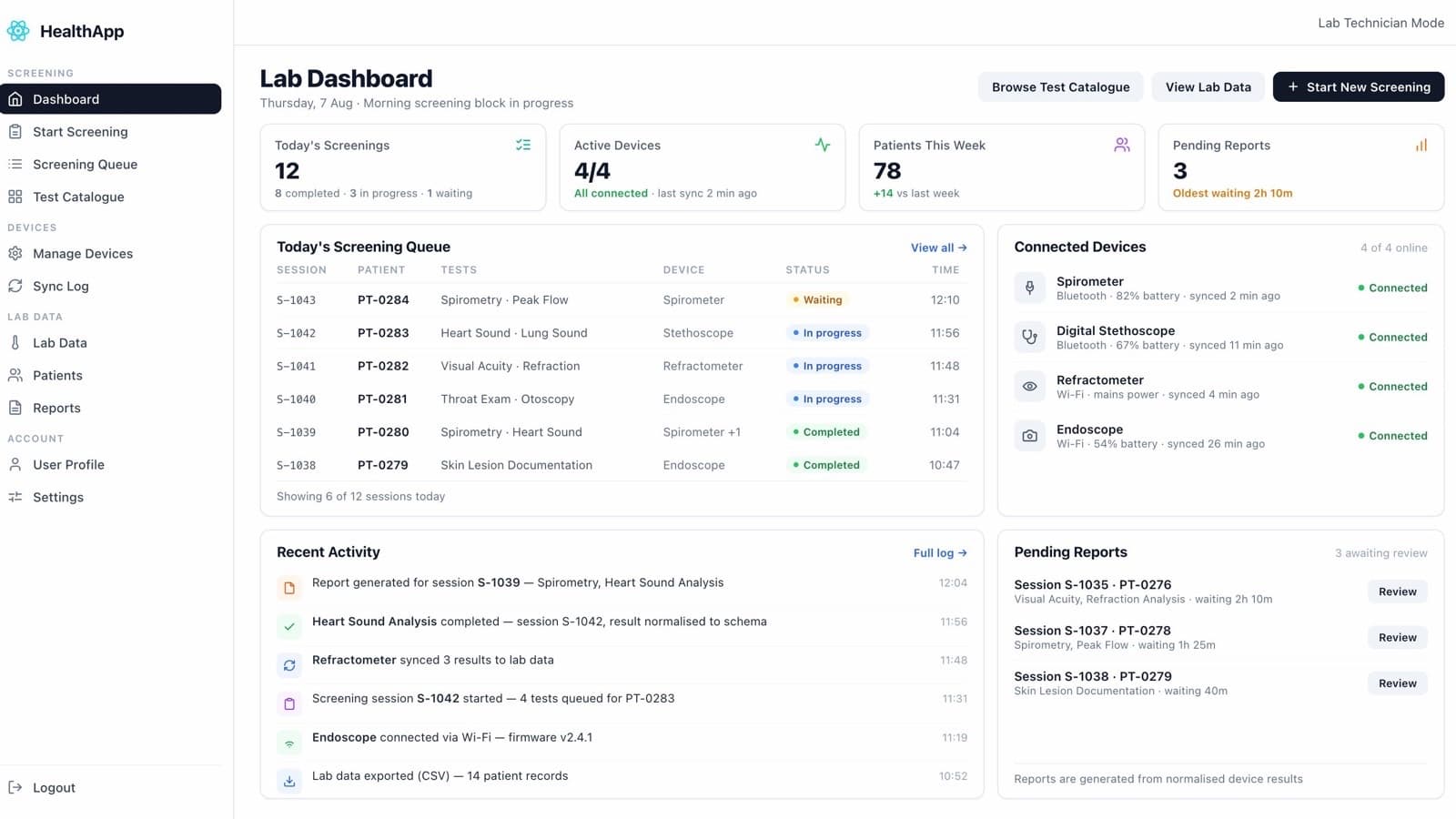
A health-check station runs several devices from several manufacturers, and each one arrives with its own mobile app and its own idea of what a result looks like. The operator ends up switching between apps to run one screening, and the results never sit together in a single record. The hard part was never the dashboard; it was that nothing in the room spoke a shared language.
We built the bridge: an adapter per device, handling Bluetooth, Wi-Fi or the vendor's own SDK behind one interface, feeding a normalisation step that maps every vendor payload into one common schema. Above it sits an operator application in lab-technician mode: a searchable catalogue of the tests each connected device can run, device management, lab data, and a screening flow that assembles the selected tests into a single session.
Device adapters handling Bluetooth, Wi-Fi and vendor SDK transports behind one interface
Vendor-specific payloads normalised into a single common data schema
A unified patient-level view in place of one app per device
Test catalogue searchable and filterable by clinical category, each test tagged with the device that performs it
Required tests marked and gathered into a single screening session
Adapter pattern: a new device is a new adapter, not a new application
- Devices
- Per-device adapters
- Normalisation
- Data layer
- Technician app
Catalogued what each device actually emits and how it expects to be talked to, before assuming any of them could be treated the same way.
One adapter per device against a single normalisation layer, with a technician-facing application proving the whole path end to end.
The adapter boundary is the point: adding a device is an adapter, not a rewrite.
Got instruments that each need their own app?
Bring the workflow and the number it affects. A reply within one business day.